
Original Sir Joseph William Chitty Vanity Fair Caricature by Spy, 1885
Back to: Vanity Fair Prints Home | Vanity Fair Paintings
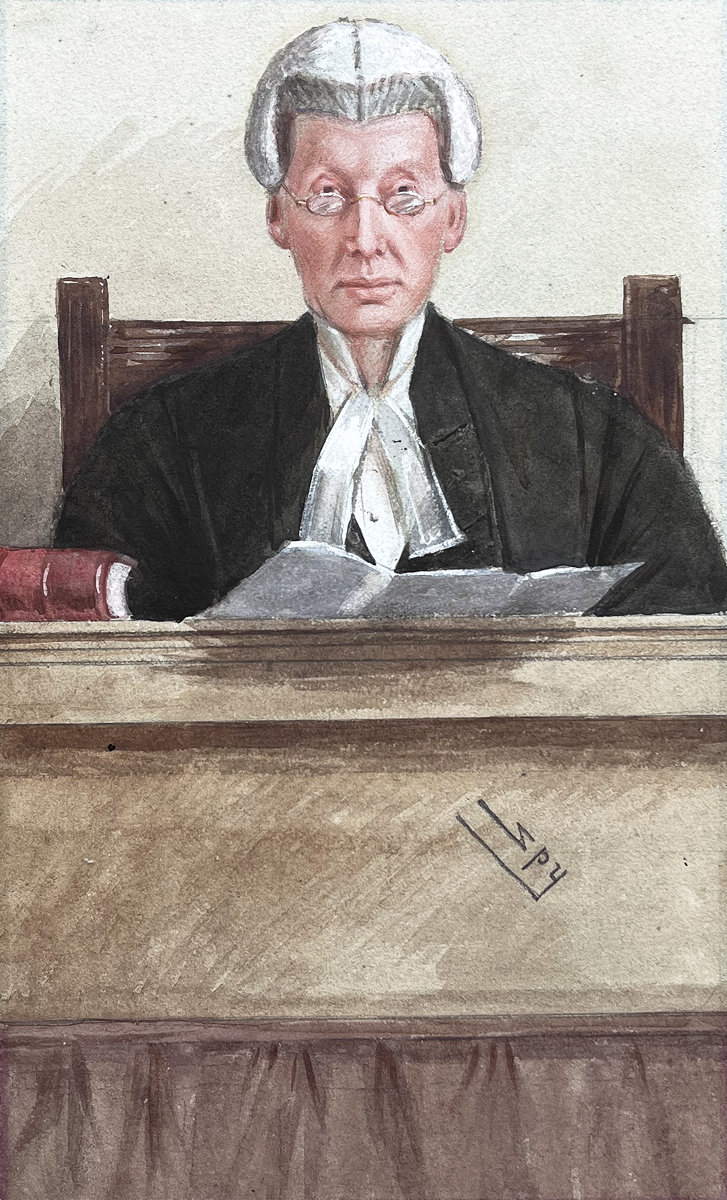
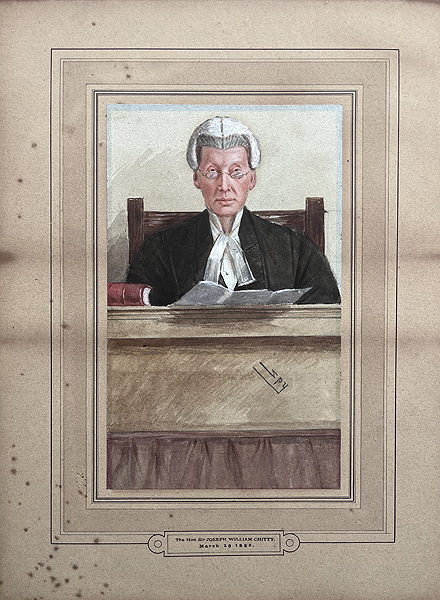
Title: Original Sir Joseph William Chitty Caricature by Spy, 1885
£2,995.00
Order No. chitty02
Date: March 28th 1885
Description: Watercolour and bodycolour painting by Spy.
Condition: Good image, supplied with Vanity Fair's original picture mount.
Image size: 375mm × 250mm
14.5 x 10" approx.
Original artwork by Spy – 1885
Choose painting-only or one of our conservation framing options below.
Click here for framing suggestions
Guaranteed original antique painting, we do not sell modern reproductions.
Sir Joseph William Chitty (1828–1899) – Victorian Judge and Vanity Fair Caricature
A distinguished Victorian judge, barrister and Liberal politician, as well as an accomplished Oxford cricketer and rower. He became a judge of the Chancery Division in 1881 and was later appointed a Lord Justice of Appeal in 1897. Today, Chitty is particularly remembered by collectors of Victorian portraits and Vanity Fair caricatures for the striking caricature published by Sir Leslie Ward, known as “Spy.”
Sir Joseph Chitty Portrait and Vanity Fair Caricature
The best-known Sir Joseph Chitty portrait is the caricature published in the celebrated Victorian magazine *Vanity Fair* on 28 March 1885. Drawn by Sir Leslie Ward under his famous pseudonym Spy, the image appeared as “Judges. No. 15.” The National Portrait Gallery records the work as a chromolithograph and lists Chitty among the judges represented in the Vanity Fair series.
For collectors, the Joseph Chitty caricature is an especially interesting example of the way Vanity Fair portrayed prominent figures of Victorian public life. The magazine's caricatures combined portraiture, personality and social commentary, making them highly collectible today as both works of art and historical records.
The National Portrait Gallery also records several other portraits of Chitty, including a photograph published in 1883 and later etchings by Charles William Sherborn after Henry Tanworth Wells.
Early Life and Education
Joseph William Chitty was born in London on 28 May 1828. He was the second son of Thomas Chitty, a celebrated special pleader and author of legal textbooks. His father was an influential figure in the Victorian legal profession, and Joseph followed the family tradition by pursuing a career in law.
Chitty was educated at Eton College before entering Balliol College, Oxford, where he achieved a first-class degree in *Literae Humaniores* in 1851. He was subsequently elected to a fellowship at Exeter College, Oxford.
His education and academic ability were matched by considerable sporting talent. During his Oxford years he became distinguished as both a cricketer and an rower
.Joseph Chitty – Cricketer and Oxford Rower
Chitty was an accomplished wicket-keeper who played for Eton against Harrow for four successive years and captained Eton in 1847. He also represented the Marylebone Cricket Club (MCC) and played for Oxford University in 1848 and 1849.
His greatest sporting achievements, however, came in rowing. Chitty represented Oxford in the University Boat Race and was a member of the Oxford crew that won the Grand Challenge Cup at Henley Royal Regatta in 1850.
He also won the Stewards' Challenge Cup at Henley as a member of the Oxford four and won the Silver Goblets, the premier coxless-pairs event, in both 1850 and 1851. In 1852 he stroked the victorious Oxford crew in the University Boat Race.
His connection with rowing continued long after his competitive career. For many years, Chitty served as umpire of the Oxford and Cambridge Boat Race, a role that helped give him an enduring association with university rowing. The Dictionary of National Biography records that he acted as Boat Race umpire for nearly a quarter of a century, from 1857 to 1881.
Legal Career and Victorian Judiciary
Chitty entered Lincoln's Inn in 1851 and was called to the Bar in 1856. He established an important practice as a barrister and became Queen's Counsel in 1874, concentrating on work in the Rolls Court under the celebrated judge Sir George Jessel.
In 1880, Chitty was elected as Liberal Member of Parliament for Oxford. His political career was short-lived, however, because in 1881 he was appointed to the High Court, Chancery Division. He was knighted later that year.
As a Victorian judge, Sir Joseph Chitty became known for his courtesy, patience, geniality and fairness, as well as his considerable knowledge of the law. His long experience in the Rolls Court had given him an extensive knowledge of case law, and his judgments were generally highly regarded.
In 1897, Chitty was promoted to the Court of Appeal, becoming a Lord Justice of Appeal. His appointment reflected his standing within the Victorian legal profession and his reputation as a knowledgeable and experienced judge.
Sir Joseph Chitty in Victorian Art and Collecting
The Vanity Fair caricature of Sir Joseph Chitty provides an important visual record of his position within Victorian society. Leslie Ward's *Spy* caricatures are now recognised as an important series of portraits of politicians, judges, lawyers, sportsmen and other prominent figures of the period.
Chitty's appearance in the *Vanity Fair Judges series reflects his position among the leading members of the Victorian judiciary. The original National Portrait Gallery record identifies the work as a chromolithograph by Sir Leslie Ward, published on 28 March 1885.
For collectors interested in Vanity Fair prints, Victorian judges, legal history and nineteenth-century portraiture, a Joseph Chitty caricature offers a particularly interesting combination of historical and artistic interest.
Legacy of Sir Joseph William Chitty
Sir Joseph William Chitty died in London on 15 February 1899, aged 70. By the end of his career he had served as a barrister, Liberal MP, High Court judge and Lord Justice of Appeal, while also maintaining a lifelong connection with sport and rowing.
His surviving portraits and, in particular, the Sir Joseph William Chitty Vanity Fair caricature by Spy, provide a lasting record of one of the notable legal figures of Victorian England.
Today, Sir Joseph Chitty portraits and Vanity Fair caricatures are of interest to collectors of Victorian prints, legal history, British portraiture and the work of the celebrated caricaturist Spy (Leslie Ward).Mon - Closed
Tues-Fri 10am-1.30pm, 2.30-5.30pm
Sat 10am-1.30pm
 Free UK Mainland Delivery*
9 Church Street
Modbury
Devon PL21 0QW. UK
01548 830872


