
Vanity Fair Print - Rev. Cannon Edward Lyttelton 1901
Back to: Vanity Fair Prints Home | Vanity Fair Teachers | Vanity Fair Clergy
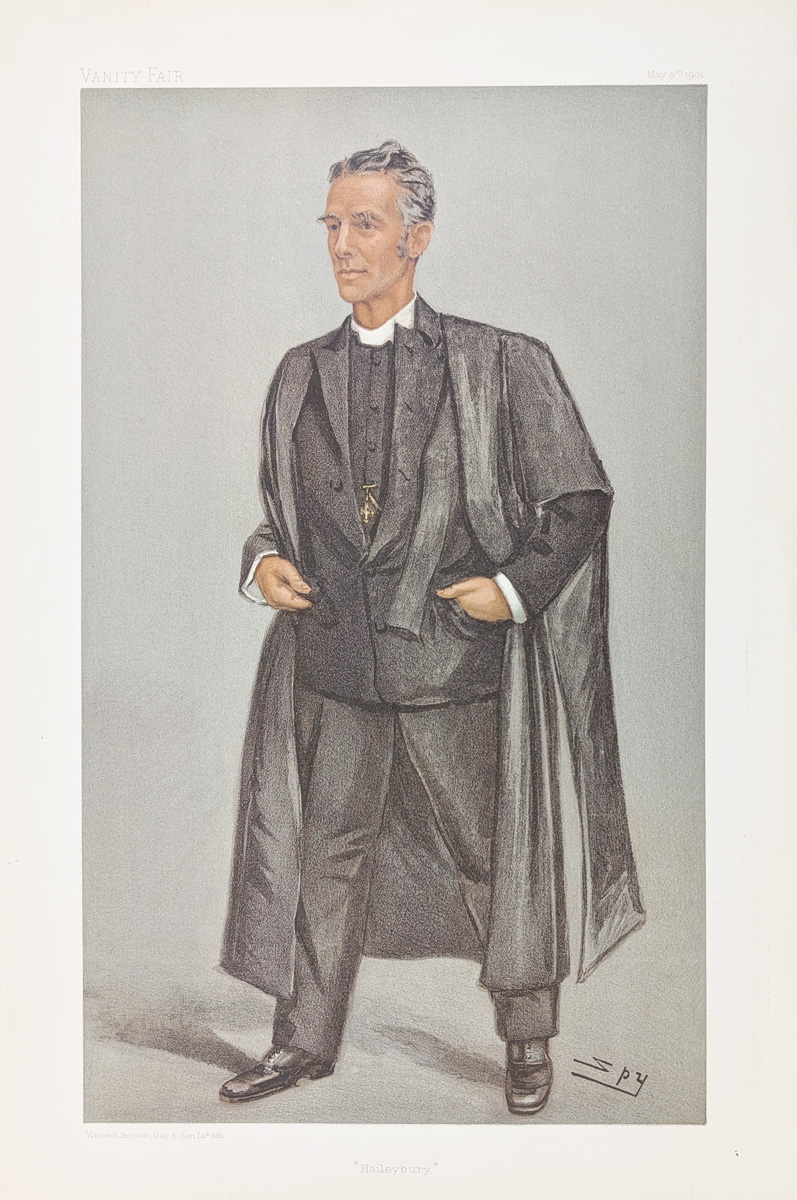
Title: 'Haileybury'
Date: 9th May 1901
Description: Chromolithograph print by Sir Leslie Ward ("Spy") for Vanity Fair.
Edward Lyttelton (1855 – 1942) was an English schoolmaster, cleric and sportsman. Was headmaster of Eton College from 1905 to 1916.
Played first-class cricket for Cambridge University and Middlesex. His brother Alfred Lyttelton also played for Middlesex CCC as a wicketkeeper. A successfull footballer, he played for England in a 7–2 defeat by Scotland on 2 March 1878. Also played in the 1876 FA Cup Final with the Old Etonians F.C., as a defender, which they lost to the Wanderers on a replay.
Condition: Good image, some marginal marks.
Image size: 370 x 210mm
14.5 x 8.25" approx.
£40.00
Order No. 11015
Rev. Cannon Edward Lyttelton original clerical caricature dated 1901
The World - Edmund Hodgson Yates (3 July 1831 – 20 May 1894) a British novelist and dramatist and was bast known as the editor of the London society journal, The World, briefly illustrated by Spy and other Vanity Fair artists. Born in Edinburgh to the actor and theatre manager Frederick Henry Yates and held an appointment for a period in the General Post Office as an adult. He worked as a journalist, mainly as a dramatic writer, and also wrote many dramatic pieces and some novels, including Running the Gauntlet and The Black Sheep.
He was a friend of Charles Dickens, and in the 1850s, Yates lived at No. 43 Doughty Street, London, close to Dickens's former home at No. 48, which is now the Charles Dickens Museum.
‘The World: a Journal for Men and Women.’ - Yates was editor-in-chief. Freed from the disgraceful personalities which had disfigured such predecessors as the ‘Age’ and the ‘Satirist,’ the ‘Queen's Messenger,’ the ‘Owl’ and ‘Echoes of the Clubs,’ the ‘World,’ after profitably encountering some not very serious legal opposition, was an established success within six months of its inception. Murray, who persisted in regarding the journal as an agency for the conduct of private vendettas, was bought out in December 1874 and the ‘World’ became the sole property of its manager, Edmund Yates. A distinctive feature of the new weekly was the frequent use of the first person singular in its columns.
Mon - Closed
Tues-Fri 10am-1.30pm, 2.30-5.30pm
Sat 10am-1.30pm
© Alpha Websites
 Free UK Mainland Delivery*
9 Church Street
Modbury
Devon PL21 0QW. UK
01548 830872


